

















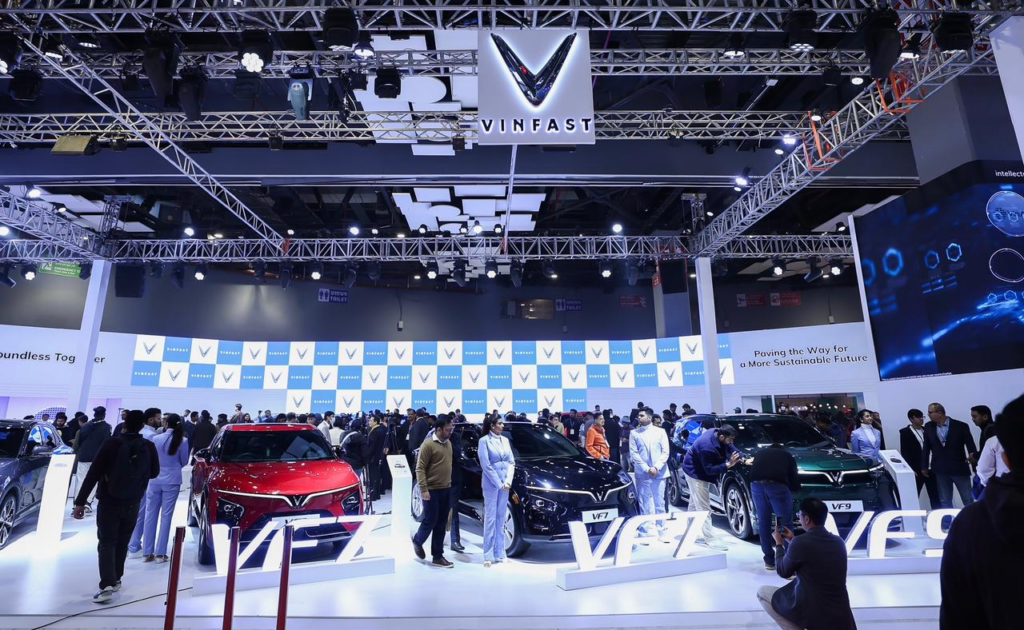
Surat: Chennai, 28th July 2025: VinFast, a Vietnamese automaker, has entered one of the world’s most difficult electric vehicle (EV) markets, where it faces stiff competition from Tata, Mahindra, BYD, and Tesla’s aspirational appeal.

With ambitious pricing, local assembly, and a technology-first approach, VinFast aims to capture the attention of India’s EV buyers. However, the company must connect emotionally with consumers in a market dominated by established local giants and powerful global brands.
VinFast has opened its first showroom in India, located in Surat, and has begun taking pre-bookings for its VF6 and VF7 SUVs. Pham Sanh Chau, CEO of VinFast Asia, has stated that the company is not just looking to sell electric vehicles in India but rather to create a complete ownership experience built on quality, trust, and service excellence while shaping a premium EV experience for Indian customers.

VinFast Seeking Its Niche in a Competitive Market
VinFast’s entry into the Indian market is at risk of being overshadowed by the competition. It could easily become another case like those of global giants such as Ford and General Motors, which have struggled against local competitors and sharper foreign rivals.
To establish its identity, VinFast must identify a distinct niche between value-driven Indian brands and aspirational global players. VinFast’s VF6 and VF7 are aimed at buyers seeking more technology and style than Tata’s Harrier EV but not willing to pay ₹45-50 lakh for a Tesla Model Y.

The VF6 features a 59.6 kWh battery with a range of 381–399 km and delivers 174–201 bhp in a front-wheel-drive configuration. The larger VF7 comes equipped with a 75.3 kWh battery, a range of 431–450 km, and offers an all-wheel-drive option producing up to 348 bhp. Both SUVs are packed with Level 2 ADAS, over-the-air updates, panoramic sunroofs, vegan leather upholstery, and app-based remote controls, emphasising VinFast’s tech-forward approach.
The company hopes to establish itself in a segment where local manufacturers dominate sales volumes, Chinese competitors like BYD gain loyalty, and Tesla serves as a benchmark for aspiration.
The VF6 and VF7, priced between ₹25-40 lakh, are aimed at urban, tech-savvy buyers who want more than Tata’s Harrier EV but are not yet ready to invest in Tesla’s Model Y.
Both SUVs promise globally competitive designs, technologically advanced interiors, and Level 2 Advanced Driver Assistance Systems (ADAS), positioning them as affordable luxury vehicles. Can VinFast truly emerge as a major disruptor in the premium EV market?
“VinFast is trying to position itself as the BYD for consumers seeking Tesla-like technology at Tata-like pricing,” says an independent EV consultant. “It’s a bold strategy, but one that will require decisive execution and extensive marketing to succeed.”

Tata’s Harrier EV, priced at ₹21.49 lakh, features a 65-75 kWh battery, 450-550 km range, and V2L functionality. This is supported by Tata’s extensive service network and brand strength as India’s leading EV manufacturer.
Mahindra’s BE range, which is priced similarly to the Tata Harrier but slightly higher, features INGLO platform-based SUVs with futuristic designs and 285-390 bhp. BYD’s Atto 3, priced at ₹33.99 lakh, remains popular among buyers due to its 521 km ARAI-certified range, Blade Battery technology, and consistent performance.
“Where Tata emphasises reliability and Tesla embodies aspiration, VinFast emphasises speed—in the way it builds, launches, and commits to supporting its vehicles. However, speed alone will not guarantee success in India,” says Rajesh Sikwar, an auto analyst based in Bengaluru.
At the top of the segment, Tesla’s Model Y, projected to cost between ₹45 and 50 lakh, stands as the aspirational benchmark, offering a range of 455–533 km, dual-motor all-wheel drive, and the benefits of the Tesla software ecosystem and Supercharger network.
Beyond the Starting Line: Branding & Marketing Strategies

If VinFast desires to find its footing, it must go beyond merely opening dealerships. While Tata and Mahindra have integrated EVs into their brand narratives through strong campaigns and influencer-driven storytelling focused on “Indian pride,” VinFast has yet to convey why Indian consumers should choose a Vietnamese EV.
“VinFast has a unique opportunity to position itself as Asia’s next mobility disruptor, leveraging Vietnam’s growth story while aligning with India’s Make-in-India objectives,” says a mobility branding consultant. “This could foster a sense of shared progress within Asia, setting it apart from Western brands like Tesla and Chinese brands like BYD,” added another analyst from a leading brokerage house
Marketing experts associated with the EV story also suggest that the company should promote sustainability rather than simply selling cars. Indians, particularly Gen Z buyers, are motivated by both value and values. VinFast should highlight its partnerships with BatX for battery recycling and its commitment to circular mobility as part of its story,” says Neeraj Kapoor, a Delhi-based automotive dealer.
Kapoor summarises the request for VinFast, saying that the company should emphasise the benefits of ownership and service excellence, as well as “build a supportive community and the overall experience that comes with choosing their brand, rather than talk about pure product benefits.”
VinFast has the potential to become a serious contender if it can find a balance between speed and Indian expectations. If not, it risks stalling on the track and being passed by competitors who have already accelerated.