























NEW DELHI, 5th June 2025

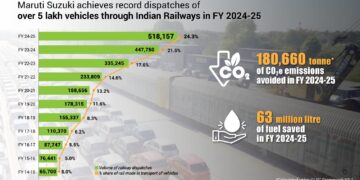
Maruti Suzuki India Ltd is establishing new standards for the use of renewable energy sources and low-emission goods as it accelerates its shift to green manufacturing and logistics. The automaker reported that it increased solar capacity by 30 megawatt-peak (MWp) across its Kharkhoda and Manesar facilities and shipped over 518,000 vehicles via Indian Railways in FY 2024–2025, its highest-ever rail volume.

Given that the company supports both the environmental vision of its parent company, Suzuki Motor Corporation, and the national decarbonisation goals, the twin announcements highlight Maruti Suzuki’s dedication to sustainable growth.
“Reducing carbon emissions is a top priority for us—across products and operations,” said Hisashi Takeuchi, Managing Director & CEO of Maruti Suzuki India Ltd “Rail-based dispatches and renewable energy initiatives are key levers in that transition.”
Since FY 2014–15, Maruti Suzuki’s use of rail freight has increased by almost eight times, totalling 2.4 million vehicles transported by the Indian Railways. The 5.18 lakh rail dispatches accounted for roughly one-fourth of the company’s total vehicle movement in FY 2024–2025 alone, saving the company over 63 million litres of fuel and 1.8 lakh tonnes of CO₂ equivalent emissions.
In order to serve more than 600 cities throughout India, the automaker now ships its cars to more than 20 hub locations via rail. Rail logistics are also becoming more and more important for exports through the ports of Mundra and Pipavav. By FY 2030–31, the company wants to increase its rail dispatch share to 35%. Currently, it operates more than 40 flexi-deck rakes, each of which can accommodate 300 vehicles.
Prime Minister Narendra Modi’s announcement of India’s first in-plant automobile rail siding at Maruti’s Gujarat facility last year gave the green logistics movement a boost by reducing transit times and reliance on trucks.
In parallel, Maruti Suzuki has expanded the size of its solar power projects, adding 10 MWp to its solar capacity at Manesar and commissioning a 20 MWp solar plant at its new Kharkhoda facility in Haryana. As a result, the company’s overall solar footprint has increased from 49 MWp to 79 MWp in just one year.

With an investment of INR 925 crore, the company has now set a target to reach 319 MWp of solar capacity by FY 2030–31. At the same time, state electricity boards are increasing the share of green power so that by the end of the decade, 85% of electricity will come from renewable sources.
“We are equally focused on making our energy mix cleaner as we scale up production to four million units,” Takeuchi stated. “This solar push is central to building a sustainable manufacturing ecosystem.”
The push for clean energy and logistics is a component of Maruti Suzuki’s larger alignment with Suzuki Motor Corporation’s Environment Vision 2050 and the Sustainable Development Goals of the UN.
The company’s dual strategy of cutting fuel-based freight and investing in solar infrastructure represents a proactive shift in how India’s leading automaker plans to balance growth with sustainability, especially in light of the growing pressures of decarbonisation and energy costs.