

















Bengaluru,June 1, 2025: Even though sales of electric two-wheelers in India reached a record high in May 2025, surpassing 100,000 units, and continued to grow by 30% over May 2024 sales, Ola Electric, which until recently was the clear market leader, is seeing a sharp drop in both sales and market share.

Rivals like TVS Motor, Bajaj Auto, and Ather Energy are taking advantage of this changing market to seize the top spots in one of the fastest-growing EV segments globally. Ola, which currently ranks third for May 2025, has seen a drop in sales and lost market share.
According to government registration data from Vahan, Ola Electric’s May 2025 sales dropped to 18,499 units, a more than 50% drop from 37,488 units in the same month the year before. From 48% in May 2025 to just 18% in May 2025, the company’s market share has plummeted, which is one of the biggest one-year drops for any player in the market.

The decline in sales is not limited to May. Ola has sold about 95,000 units in the first five months of 2025, which is a sharp decrease from the 191,685 units it sold in the same time frame in 2024.

Ola’s decline is attributed by industry analysts to a number of factors, including increased competition, a slowdown in model innovation, and growing customer dissatisfaction with after-sales service.
Another analyst from a leading broking firm observed that although Ola was first praised for democratising electric mobility through audacious pricing and extensive digital distribution, the company is currently finding it difficult to hold onto its early lead.

TVS Motor Company, on the other hand, has seized the moment. With 24,562 units sold in May 2025, the Chennai-based automaker more than doubled its sales year over year from 11,867 units in May 2024.
TVS holds a 24% market share and is the market leader at No. 1 Spot for May 2025. The redesigned TVS iQube is largely responsible for the company’s numbers showing a sharp upward spike, with a price reduction of over ₹25,000 and an increased range of 150 kilometres on a single charge.

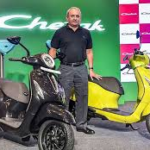
Bajaj Auto is ranked number two in May 2025, just behind TVS. The Pune-based automaker recorded 21,770 units in May 2025, up from 9,249 units the previous year, a 135% increase in sales. A major factor in the Chetak electric scooter’s current 22% market share is its excellent traction, particularly in urban areas.

Ather Energy, based in Bengaluru, also demonstrated strong growth at No. 4, recording 12,840 units, an increase of almost 100% from 6,155 units in May 2024.
The success of Ather’s Ritza model, which has sold over 100,000 units since its launch in July 2024, has contributed significantly to the company’s current 8% market share. Ather has been able to expand beyond its premium niche and enter smaller cities thanks to The Ritza’s affordable prices and useful features.
The top five is rounded out by Hero MotoCorp’s Vida, which registered 7,164 units in May 2025, a 191% increase over last year’s 2,460 units. With dealership growth and increased brand awareness, Vida is gradually gaining traction and currently has a 3% market share.
With sales of roughly 4,100 units, Greaves Electric Mobility, best known for its Ampere brand, took sixth place. Greaves is still a niche player, but it has been growing its dealership network and product line over time.
Pur Energy (1,270 units), E-Sprinto Green (1,149 units), Kinetic Green (1,128 units), and BGauss Auto (which placed tenth in May with sales just over 1,000 units) are other noteworthy players.
The market for electric two-wheelers as a whole is still growing quickly. Sales increased 30% year over year to 100,266 units in May 2025 from 77,330 units in May 2024, highlighting growing consumer acceptance and developing EV infrastructure throughout India.

Still, the shake-up in market share has rattled expectations. Ola’s decline serves as a metaphor for how quickly India’s EV market is developing. The segment is maturing, and now reliability, service, and product quality are becoming key differentiators,” said a senior auto analyst at a Mumbai-based brokerage.
The competition in India for electric mobility is intensifying as new players join the market and established firms aggressively broaden their product lines. “The road ahead will require more than just bold headlines for Ola—it will require a strategy reboot to regain lost ground,” an analyst with an MNC consulting firm said.